
This is a recording of an interview between Rachel Hunt and Professor Nigel Bertram about the demolition of Melbourne’s Public Housing Towers on ABC 774 on The Conversation Hour 19 02 2025.
Submission to Parliamentary enquiry into the demolition of Melbourne`s public housing towers. (Legislative Council Legal and Social Committee)
On 20 March 2024, the Legislative Council agreed to the following motion: That this House requires the Legal and Social Issues Committee inquire into, consider and report by December 2025 on:
Terms of Reference.
Contents
- Introduction
- The Elgin Towers
- Approval Systems Report
- Demolition notice
- Red brick towers feasibility study Hayball Architects
- Homes Victoria Board Appointed by Richard Wynne
- Chair of Holmes Victoria
- The Property Council.
- Discussion and questions
- The failure to investigate the Social Consequences.
- Inquiry into the public housing renewal. Submission by Dr Kate Shaw
- A brief history of Public Housing Development Encompass, Merri, Academy
- A report by Office on the three towers at the Flemington Estate.
- The Supreme Court Hearing
- Letter to Samantha Ratnam
- Conclusion
Introduction
The plan to demolish all 44 public housing towers and place this valuable public asset into the hands of the property developers can only be described as the mining of a public asset by a privileged few for their own financial benefit.
The plan presents images of colonial exploitation dating back to the invasion of Australia and the proclamation of Terra Nullius. Colonial empowerment has always been motivated by profit accompanied by the tools of plunder and a failure to recognise the needs of the villagers who occupied the lands prior to the colonisation.
Currently we have 44 publicly owned towers situated upon some very valuable real estate which house over 10,000 of our most vulnerable citizens. These towers are their homes, within the towers are communities of people who support one another during their daily lives. Some are older people, some are families who have arrived from war torn parts of the world, others are families who have fallen upon hard times through no fault of their own, there are many children living in these communities.
All of these people are familiar with their surroundings, the schools, the shops, the medical facilities, work and many other community facilities upon which they rely upon. The current proposal has ignored their needs as human beings and very much appears to be treating them as livestock. We can relocate a sheep from one area to another dislocate it from the flock and expect it to just go on with life.
Human beings are part of families and social networks which are formed by the places where they live. When one uproots a vulnerable family, the children are forced into a new school where they have to form new friendships and are more likely to be bullied, particularly if they have come from overseas.
Older people who are relocated into a different area lose contact with their immediate family and friends, do not know where to shop or obtain medical services, just for a start.
The decision to demolish and rebuild all 44 of Melbourne` Public Housing Towers emanates from reports by Architects, Building Surveyors, Engineers, Infra Structure project consultants and the Real Estate Industry, under the direction by Homes Victoria. Social planners, educators, community developers have not been requested to submit a balanced perspective on the plan.
The plan being to capture the public housing asset demolish the homes of at least 10,000 people and transfer as much as possible of this asset into the hands of private enterprise without any regard whatsoever as to how this will impact upon the well being of our families and the communities that are affected.
One only needs to read this document to begin to understand the gravity of the situation. https://www.parliament.vic.gov.au/4a26ee/globalassets/tabled-paper-documents/tabled-paper-8383/letter-from-the-attorney-general—production-of-documents—redevelopment-of-public-housing-towers.pdf?fbclid=IwY2xjawG_P9BleHRuA2FlbQIxMAABHZ2MI2dTPzvHNv3jukqHlLX6uGPOhaWKYGyZHHs-o1yatEIIJ5l0-7Pu2w_aem_rTs5G-AaJWeHnjt_b2hQmw
Colonisers do not respect the culture of the village and the laws of the coloniser do not have any respect for family or community within their fabric. The treatment of the 10,000 people whose homes are within those towers by this plan comes as no surprise when one understands the tragic history of this country.
There are at least 65,000 people currently on the public housing waiting list
The Elgin Towers (Carlton)

I became aware of the relocation at the end of 2019, about two years prior to the decision to demolish all 44 public housing towers, when the residents of 141 Nicholson Street and the adjoining brick tower in Elgin Street were informed, they had to relocate. At the time the Department of Public Housing stated they had to move due to problems with the mains water supply. (The main water pipes into both towers were leaking and required replacement). Many of the residents relocated to the Northern side of the towers as the plumbing works were planned for the southern end.
See notice.

The Department of Families and fairness was established 1st February 2021. Homes Victoria was established on 14 May 2021
“The 11-member board will oversee the rollout of the landmark Big Housing Build, the development of a 10-year housing strategy, and other major initiatives and reforms to provide secure, affordable housing to those who need it most”
The residence who had relocated so as to accommodate the proposed plumbing works, (Which had not commenced?) received a notification from Homes Victoria in late 2021 that they would have to be relocated to another building still believing their relocation was as a result of a need to carry out the required plumbing works.
Within 18 months of evacuating the buildings the messaging from Homes Victoria changed to: “We have to demolish the two buildings because of their condition”?
See report. Dated 5th April 2022
This report was commissioned by Homes Victoria. The report was written by Joe Zita a qualified Building Surveyor. Also, an Accredited Building Surveyor/Auditor – Department of Families and Fairness.
Homes Victoria sits within the Department of Families and Fairness.
Joe Zita Approval Systems
- Diploma of Building Surveying, Swinburne University of Technology
Graduate Diploma of Building Fire Safety and Risk Engineering, Victoria University
Accredited Building Surveyor/Auditor – Department of Family, Fairness & Housing
Accredited Consultant – Department of Transport (Victoria)
Australian Institute of Building Surveyors – Accredited Member
Building Appeals Board (Victoria) – Member since 2010
Royal Institution of Chartered Surveyors (RICS) – Member
Society of Fire Safety (IE Aust) – Member
Society of Fire Protection Engineers (SFPE) (USA) – Member
Waterproofing Association of Australia – Member
Australian Institute of Building Surveyors – Building Surveyor the Year 2017
In the case of the Elgin Towers. We had two buildings which contained 198 residences.
These buildings have been evacuated and have been empty for the past three years.
The water pipe and the sewerage system could have been repaired with the residents in-situe for a cost of less than $200,000, but it was decided to empty the two buildings.
A building surveyors report suggests the buildings have to be demolished and rebuilt at a cost not yet revealed? No less than $170 million based upon estimates from Office Report Retain Repair Reinvest Flemington Estate: The cost of demolition alone will be in the order of $40 million and we will gain 50 more residencies.
A contract to demolish five towers has been awarded to John Holland for $100 million. This contract includes the two Elgin Towers. Note John Holland is a Chinese owned company. John Holland Pty Ltd is a member of The Property Council of Australia.
The demolition plan for the two Elgin Towers is progressing despite there being:
A court case being held in the Supreme Court of Victoria concerning the Human Rights of the proposed demolition of the three public housing towers in Flemington.
A parliamentary inquiry held by The Legislative Council Legal and Social Issues Committee into the demotion of the 44 public housing towers of which two are the Elgin Towers.


Red brick towers feasibility study Hayball Architects
Hayball Architects have prepared a feasibility study and option testing report for Homes Victoria. Note: Hayball Architects are a member of The Property Councilhttp://www.lawyersorgraverobbers.com/web2/wp-content/uploads/2025/03/red-brick-towers-feasibility-and-option-testing-by-Hayball.pdf
I understand that the body set up to orchestrate these changes is “Homes Victoria” created by the now retired Minister for Planning Mr Richard Wynne. http://www.lawyersorgraverobbers.com/web2/wp-content/uploads/2025/03/210514-Homes-Victoria-Board-Announced.pdf
Homes Victoria became the asset manager for all public housing in Victoria.
The Chair of Homes Victoria
The Inaugural Chair of Homes Victoria. Was Steve Gross ex Macquarie Group, Global Head of Impact Investing. Note Macquarie Group are Members of The Property Council of Australia.
The board members of Homes Victoria have obviously changed during the past three years, a quick search on the internet has unearthed the following which may be of interest to you.
I have always been interested to understand where this idea of demolishing these public housing towers has come from, and in whose interests this plan benefits?
I have enclosed some information below, you may find the association between the new chair of the Advisory board of Homes Victoria, Mirvac and The Property Council of Australia interesting.
https://www.mirvac.com/about/news-and-media/Spotlight-on-our-Social-Enterprise-Program
Sarah Clarke, Mirvac Group General Manager, Sustainability
Homes Victoria advisory board members
Sarah Clarke Chair
“Sarah Clarke is a leader at the forefront of building responsible, sustainable, people-focused organisational capability. She brings a focus on environmental and social governance, culture, strategy, risk, and public affairs to help meet contemporary stakeholder expectations. She has led functions in the corporate, government, and charitable sectors, delivering outcomes which align purpose with profit.
Her core capability is in navigating and solving problems in complex contexts – identifying material issues, designing pragmatic commercial responses, and influencing through engaging storytelling.
Sarah’s experience across multiple sectors and industries enables her to see the system in which companies operate, successfully forecast risks, and design strategies which enhance trusting stakeholder relationships. She has led corporate communications and sustainability portfolios in property, public and government affairs in transport, community engagement in energy mega projects, held executive roles with the Australian Government, and senior advisory roles with the Victorian Government.”
Property Council of Australia.
Our members. https://www.propertycouncil.com.au/membership/our-members
Three that come to mind are.


It should be noted that Simon Newport the recently appointed CEO of Homes Victoria was shipped in from New South Wales where he was CEO of the NSW Land and Housing Corporation. He has hands on experience in dealing with the demolition process of Public Housing Estates, see Waterloo. https://www.tandfonline.com/doi/full/10.1080/02665433.2024.2337268#abstract
Discussion and questions
From the position of a naïve member of our community it appears as if the decision to demolish the Elgin Towers was a foregone conclusion driven by the interests of The Property Council of Australia. The cosy relationship between The Property Council and the advisory board of Homes Victoria with the idea in place to demolish, was then set into play.
The first action required, was to remove the tenants from the Elgin Street Towers. This was achieved through the auspices of the towers requiring extensive works to the water and sewerage systems.
Once the Towers were evacuated, the architects Hayball were commissioned to make a report along with the building surveyor; Joe Zita from Approval Systems whose brief was to ensure the towers were condemned by nit picking the existing building codes.
The building surveyors report conducted by Joe Zita, Director of Approval Systems then opened the door for assessment of all 44 public housing towers and their proposed demolition.
A veritable pot of gold for the property Industry!
It will take at least another 4 years before the Elgin Towers development is completed which means 198 residencies IE people’s homes; where families and people could have lived are made unavailable. At least 400 people who lived in those towers have had their lives completely turned upside down.
What will we gain in the end, after seven years and spending at least $170 million, we will have two nice new buildings which will blend in with the aesthetics of the street scape and a debt of $170 million dollars with at least 300 people who could have been housed still waiting for a place to live in.
- How much dysfunction on a social level has this caused, how many of those people will have died, some of whom will have died or suffered serious illness from the trauma of dislocation?
- How many young people will end up in jail or disadvantaged for life due to changing schools, friends and the disadvantage that comes along with this dislocation. In other words, how much, social damage will be caused because of the decision to demolish rather than to repair and restore the existing towers. A decision to favour the property industry has been made so as $170 million is spent on building two new towers.
Image if that $170 million had been spent on building more public housing homes whilst at the same time keeping the existing towers occupied.
The reconstruction will create 248 residencies at a cost of at least $170 million.
- The weekly interest bill on each residence at a nominal rate of 4.35% will be $580.
- Hence the rent will have to be at least $580 per week just to cover the interest bill. Hardly affordable housing for a person on a pension of $543 per week.
From the reports I have read; written by Building Surveyors and Architects the emphasis is on compliance to building codes. There is no mention of the negative social ramifications on the people whose homes are to be sacrificed for the sole purpose of enriching the pockets of those who work in the property sector.
The noncompliance issues raised such as:
- The width of the staircases being 100mm to narrow. At 900 mm and not 1000m. Note: The staircases are rarely used and there are two stair cases in the Elgin Towers.
- The width of the front entrance door to each unit being 20 mm to narrow. Note: The increased door width I presume is to allow wheel chair access into every apartment. To be brutal, not everybody travels in a wheel chair and if they are unfortunate to require a wheel chair then yes some of the lower-level apartments will require a larger door frame.
- No fire sprinklers on the balcony. Note: How many fires have we had on a balcony. The problem with balcony fires is when there is flammable cladding on the building which allows the fire spread rapidly upwards, this is not so in the Elgin Towers. It may be a good idea to not permit hoarders to store their possessions on the balcony?
- The floor thickness being 150 mm and not 200mm. Note: Nobody has asked the residents if noise is a problem?
- The need to double glaze all windows. Note: A simple blind will help improve the energy efficiency at a far lower cost and when considering the energy expended to replace the existing windows with double glazing with a payback period of 209 years one could well find there is a net energy deficiency over the period rather than a net saving. Has the calculation been done.
Were Sustainable Victoria involved in the decision-making process. See report Comprehensive Energy Efficiency Retrofits to existing Victorian Houses? https://assets.sustainability.vic.gov.au/susvic/Report-Energy-Comprehensive-Energy-Efficiency-Retrofits-to-Existing-Victorian-Houses-PDF.pdf
Window film secondary glazing retrofit trail. https://assets.sustainability.vic.gov.au/susvic/Report-Energy-Window-Film-Secondary-Glazing-Retrofit-Trial-February-2017.pdf
Yes, these are all issues, but is it common sense to remodel a functioning existing building which is going to be structural sound for the next fifty years, to conform to a new building code at exorbitant cost when we have a housing crisis where the public housing waiting list is growing and has now reached over 60,000 people?
Some are sleeping on the streets and many just living out of their cars.
The relationship between The Property Council and Homes Victoria appears to be a cosy one that could well have a serious conflict of interest. Particularly when one considers that Homes Victoria is housed within the Department of Families and Fairness.
Has The Auditor Generals Department run their eyes over the proposal to demolish all 44 Public Housing Towers including the two Elgin Towers and what have they said about the idea?
One would think that the goal of the Department of Families and Fairness would be to enshrine the wellbeing of the vulnerable families who need affordable housing. Instead, it appears as if The Department of Families and Fairness through Homes Victoria is more interested in advancing[DH1] the profits of the members of the Property Council, the entity that looks after the interests of the property developers, builders, architects, building surveyors, financiers, lawyers and the building and property industry.
- Is there an official independent report that focuses upon the wellbeing of the public housing tenants with a holistic analysis of all of the issues, both economic and social. The current reporting system appears to have a very narrow focus?
- Has there been a thorough analysis done of the two buildings known as The Elgin Towers by an independent engineer who has not got a vested interest with The Property Council of Australia. I realise it will be very difficult to find such a creature who cannot be bribed or intimidated by such a powerful group, but I ask where is that report?
Where are the projected cost estimates for rebuilding the towers, including:
- Cost of build
- Cost of demolition
- Cost of planning and architecture
- Cost of Relocation of the people who lived there
- Loss of rent
- Education dislocation costs
- Health of tenant’s costs due to dislocation
- Damage to the carbon load
Where are the cost estimates for refurbishment without demolition using a practical common-sense approach?
Is it really necessary to widen each front door, put double glazing on all of the windows, put sprinklers on the balcony, increase the thickness of the ceilings, and widen the stairwells: or is that just an excuse so as the demolition and rebuild can be justified?
Would it not be much better for the well-being of our people to not waste this money on unnecessary building works and either spend it on:
- Building more public housing elsewhere?
- Social development programmes including improving access to education for the children who live in public housing and creating employment opportunities for the adults who live there?
Currently due to the disruption created by the demolition plan many of the socially cohesive programmes available to the people who lived in these towers has gone into free fall and has almost disappeared. This looks very much like part of a deliberate plan to dislocate and weaken these vulnerable communities.
The failure to investigate the Social Consequences.
Where are the opinions of our social planners and would it not make sense to obtain a report from an independent entity such as an Academic institution with a holistic perspective on the issue rather than leaving it the hands of the building and property industry whose focus is on making a buck and ignore the wellbeing of our community?
Here is an example of such a report.
Inquiry into the public housing renewal. Dr Kate Shaw
Dr Kate Shaw has a long history of research into public housing estates and their development as an urban geographer and planner at the University of Melbourne. This includes in particular an evaluation in 2012 of the Kensington estate redevelopments for the then-Department of Human Services, in collaboration with Dr Peter Raisbeck of the Melbourne School of Design, University of Melbourne; Chris Chaplin, currently with the Port Phillip Housing Association, and Professor Kath Hulse of Swinburne University (Shaw et al, 2013).
“The Department chose not to release the report from that evaluation.”
1. Rationale for public housing estate redevelopments
Public housing redevelopment policy draws for its legitimation on the neighbourhood effects thesis,which says that concentrations of poverty exacerbate the effects of that poverty. The concept of deconcentrating neighbourhood effects, or place-based disadvantage, arose in the US and was carried over to the UK to Canada and Australia in a profoundly inappropriate process of policy transfer.
While negatively compounding effects might apply in large areas of consistent deprivation such as the rust-belt cities of the US and parts of the UK – where a massive contributor to disadvantage is race and racism – their translation to the well-resourced, already culturally-mixed and gentrified inner-cities of Sydney and Melbourne is absurd.
It appears as if we in Australia have copied the same model for Estate Development derived from Neo Liberal Economics. A case Monkey see Monkey Do.
Homes Victoria have not released any documentation as to how much the demolition and redevelopment of the 44 Public Housing Towers in Melbourne will cost.
Let alone the finer details of the plan:
- Will the developer have ownership of the land?
- How much will each residence cost?
- How many residences will remain as public housing?
- How many residences will be built for private sale?
- How much profit is calculated to be made?
- Who will be financing these redevelopments?
- How will the redevelopment be manned, particularly when there is a current shortage of skilled trades people who are trained with the appropriate building skills?
- How much of the raw materials and fixtures, fittings and equipment will be imported?
- Is there a plan to optimise local input and avoid the latest catastrophe of the importation of 28,000 tons of Cheap, Unsafe Imported Steel? https://newshub.medianet.com.au/2024/10/victorian-government-decimates-local-industry/70390/
A brief history of Public Housing Development
There are quite a few so-called developments of public housing estates which have occurred over the past few years. All of which have allowed property developers to profit, have disrupted the lives of the residents and have supplied very few more public housing residencies.
Here are three such developments.
Encompass on the corner of Elgin and Nicholson Street Carlton. Academy in North Melbourne. Merri in High Street Northcote.
Encompass
Encompass involved the development of a vacant block of public land by the Frasers Property Group, also a member of The Property Council. A company that happens to have its offices in the Cayman Islands and is owned by a Chinese Billionaire run out of Singapore. The development contains no social or public housing.
The beginning of Construction.
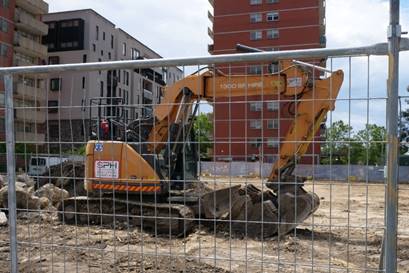
Academy
Academy in North Melbourne and Merri in Northcote involved the demolition of the low-rise public housing units and the evacuation of the residents.
Academy The housing project, Academy North Melbourne, at Abbotsford St is part of the state government’s Public Housing Renewal Program, which has so far seen 112 public housing dwellings built in the 1950s demolished at the estate.
They will be replaced with 300 new apartments for private buyers, including 133 social housing units, under a state government partnership with developer MAB Corporation another member of The Property Council. The social housing units will be managed by Housing First when the development is complete.

The beginning of Construction.
Merri
About the project
Homes Victoria is delivering new social and market homes at the Walker Street housing site in Northcote, providing modern, high-quality and energy-efficient homes to the local community.
Located just 5 km north of Melbourne’s city centre, the site is ideally positioned near public transport, community services, shops, schools and key destinations including the Merri Creek and Ruckers Hill.
This housing development will replace 87 social homes that were not fit for purpose with more than 200 new homes, including 99 social homes and 151 market homes, delivering a 14 % increase in social housing at the site.
The supply of new housing at the Walker Street site is a key part of the Victorian Government’s strategy to provide more and better homes for Victorians.
Homes Victoria has partnered with MAB, including Brady Group as the builder, and experienced community housing provider, HousingFirst to deliver this important housing project.

After demolition, The beginning of Construction.
Once construction is complete, all social housing at Walker Street, Northcote will be managed by HousingFirst who will deliver supportive tenancy management and maintenance services for a 20-year period.
A report by Office on the three towers at the Flemington Estate.
Retain Repair Reinvest Flemington Estate: Feasibility Study and Alternative Design Proposal OFFICE http://www.lawyersorgraverobbers.com/web2/wp-content/uploads/2025/03/OFFICE_RRR_Flemington-Estate_Report.pdf
Fast facts
This process begins from the rationale that refurbishment is not a viable option—despite no feasibility study for the renovation of the estates being available to the public.
The objective of Retain, Repair, Reinvest is to understand whether it is both technically and economically feasible to retain the existing public housing via refurbishment and where appropriate, to advocate for retrofit and infill to provide greater social and environmental benefit.
RRR identifies the uncaptured costs associated with the High-Rise Redevelopment Program approach at Flemington Estate and redirects these savings into the existing public housing stock and new infill. These costs include the relocation of existing tenants, disruption of communities and demolition of existing buildings.
This Retain, Repair, Re-invest report addresses all of the criteria presented by Homes Victoria that justify estate demolition—including energy efficiency, liveability standards, structural integrity of the towers and additional housing capacity through infill.
Key Findings
This study demonstrates how a Retain, Repair, Re-invest strategy can address all of the objectives of the HRRP, and deliver improved living conditions for lower direct financial investment from the government.
As outlined in Table 1, the RRR feasibility study has found that a refurbishment of the existing public housing, combined with infill of new social housing dwellings can be delivered for $519,386,582 ($400,000 per unit), while retaining the existing community on site and avoiding the social impact and economic costs of relocation. A demolition and rebuild approach would cost $882,994,835 ($680,000 per unit).
The RRR study proposes that it is possible for the $364 million of financial savings to be reinvested back into the refurbishment of the existing public housing and development of new social housing. The HRRP does not provide financial, social or environmental benefit, and improved outcomes could be delivered for significantly less government and private investment.
1.8 Limitations
The report is based on data, budgets, reports and findings that are publicly available.
OFFICE and collaborators have submitted formal FOI requests and direct information requests to Department of Families, Fairness and Housing (DFFH) for the following information in relation to the Flemington Estate demolition and redevelopment:
● Recent structural assessments that determine the structural condition of 120 Racecourse Road
● Maintenance reports and service assessments for 120 Racecourse Road
● Public Records of Victoria Index number for the original architectural and structural drawings form 120 Racecourse Road
● The asset management work that details the government’s review and costings for the 2.3 billion for maintenance and upgrades, including details of what that 2.3 billion would cover (e.g painting, renovations)5
● Details of the current energy efficiency ratings of the Flemington and North Melbourne public housing towers6
● The number of currently vacant public housing tower dwellings, in non-vacated towers
● Government costings for the temporary relocation of public housing residents, including translator fees, cleaning fees, removalists, and private-rental costs for any residents not accommodated in alternative public housing7
● Documents of the level of government investment, built outcomes and ongoing maintenance budgets for the recently renovated North Richmond and Collingwood public housing towers8
● The rationale for commencing with Flemington and North Melbourne sites being in the first tranche of demolition and redevelopment
● Any HV commissioned or internally conducted studies exploring alternatives to demolition and rebuild
● Current tenant and household numbers currently residing at Flemington Estate
● How many bedrooms are in the new community housing at Victoria and Abbotsford Street
● Clarification on Section H of the Relocation Agreement on the right to return, and how this is managed in relation to ‘Insufficient redevelopment housing’ where there is not sufficient space for original tenants to return to.
Following complaints submitted to OVIC to assist with the FOI requests, we received:
- 37 pages of redacted visual site assessments, asset records and maintenance site visit logs for 120 Racecourse Road
- The Public Records Index Number (however the two contracts/drawings were not held by the PROV and were not found by DHHS).
- Data that there were 513 public housing dwellings in the non-vacated towers
In the absence of access to almost all requested key documents, this report is based on publicly available information. As reported by The Age – which was denied access to 941 pages of documentation—there is a lack of transparency around the High-Rise Redevelopment Project. In July 2024, Labor responded to a motion from the Greens that demanded the release of documents justifying the wholesale destruction of the towers, by blocking 146 out of 158 relevant documents.9 This has both limited the evidence available to draw upon in this feasibility study, while simultaneously highlighting the necessity of a publicly available report that details either the necessity for demolition or potential for retrofitting.
Synopsis of the Office report.
- The Retain, Repair, Re-invest report by office saves the government $227.7 million in direct relocation costs, and approximately $5million in associated health and well-being costs as well as reduced construction costs. The RRR proposal also provides a 55% reduction of global warming potential compared with the HRRP approach.
- Requests for Information from the Department Families and Fairness in which Homes Victoria sits have shown they are uncooperative in reciprocating.
The Supreme Court Hearing.
Residents in public housing towers slated for demolition will not learn if they are successful in their fight against the Victorian government until next year.
The class action claims Homes Victoria did not properly consider the residents’ human rights before deciding to demolish the towers in Carlton, Flemington and North Melbourne.
The decision was announced by former premier Daniel Andrews as part of the Labor government’s policy in September 2023.
The trial began in the Victorian Supreme Court on Monday, where Homes Victoria chief executive Simon Newport conceded Mr Andrews made the announcement before residents were notified.
He told the court the government body did carry out community consultation afterwards, including an open forum.
The trial was due to continue on Tuesday but the case was instead adjourned so the parties could fight over the production of secret documents.
Lawyers for Homes Victoria told the court some of the requested material falls under “cabinet privilege” and does not need to be released.
Justice Melinda Richards said another judge would need to decide on the document question, with a hearing date yet to be fixed.
She was originally planning to hand down her decision in the class action trial within the next two months but the legal argument will delay her ruling.
“I had expected to give the parties a decision by the end of the year,” she said on Tuesday.
“That’s now no longer going to be possible.”
The trial has been adjourned to a date to be fixed.
“Another example of legal Skull-Duggery or should I say more accurately THUGGERY.”
Letter to Samantha Ratnam http://www.lawyersorgraverobbers.com/web2/wp-content/uploads/2025/03/Letter-to-Samantha-Ratnam.pdf
Conclusion.
- The Office report on the three Flemington towers indicates a saving of at least $230 million. If this saving is extrapolated over the 44 towers there is an estimated saving of $230×44/3 = $3.4 billion. This does not include the costs of, loss of rent approx. $100 million, costs to local people due to massive traffic disruptions during the build, cost to the environment due to the increase in carbon. The cost of more imports from overseas.
- The Office report, the current Supreme Court Trail and the report by Dr Kate Shaw all point to a process of opacity and an imbalance in power. We are managing a public asset which houses are most vulnerable people. The process requires open and transparent communication. The only reason transparency has been clouded by opacity must be because certain entities stand to gain from the idea of demolishing the 44 public housing towers. From where I come from, we call that corruption.
- There is at least a saving of $3.5 billion in savings if a program of Retain, Repair is implemented leaving $3.5 billion for reinvestment.
- Much of this $3.5 billion can be invested into social cohesion initiatives, which are desperately required to heal and develop our communities and the families who make up those communities.
- The proposal by Homes Victoria as part of The Department of Families and Fairness, to demolish the 44 public housing towers in Melbourne is a perpetuation of the cruelty which began in Australia 236 years ago. A cruelty which puts money and power above the well being of the people who live in this country. The Department of Families and Fairness and its associates should hang their heads in shame and seriously reconsider their proposal a proposal that can only be described as one of lunacy created by a band of self-interested nincompoops.
- Please consider the huge number of shipping containers required to import all of the doors, door frames, double glazed windows, light fittings, steel, electrical conduit, pipe work, ect ect ect, as I am sure any plan to purchase product locally will be abandoned due to costing factors?
- I can only hope that the current examination by the Legislative Council Legal and Social Issues Committee will work with integrity, in the interests of all Victorian Citizens to join the dots so as to reveal and prevent this debacle, primarily created by Homes Victoria and reveal the corruption within.
- The total cost of demolishing and rebuilding the 44 Public housing towers will be an estimated $13 Billion Dollars. There does not appear to be a financial plan in place which describes in detail how this project is going to be financed, who will provide the finance and how will it be paid for.
- It looks as if this idea was thought up prior to the steep rise in interest rates which have increased threefold since its inception. Would it not be a very good idea to re-assess the whole project with a fine-tooth comb in light of these changes alone?
- History will tell us that when the finances are squeezed all good intentions are thrown out the door. This could very well happen with regards to the number of residences allocated for public, social, community housing vs privately owned units. One can take guidance from the words of the Song Treaty sung by Yothu Yindi.
Well I heard it on the radio
And I saw it on the television
Back in 1988 All those talking politicians
Words are easy, words are cheap
Much cheaper than our priceless land
But promises can disappear
Just like writing in the sand
Yours Sincerely
Diarmuid Hannigan. (B Mech Eng)
The Community Collaborators Pty Ltd.


